
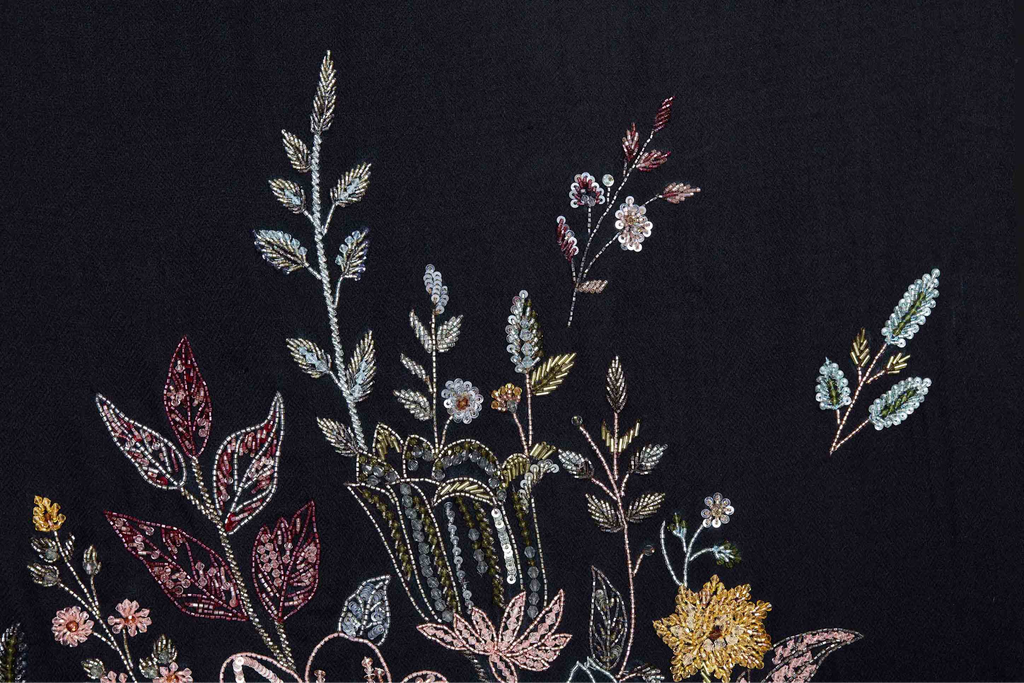
Here is a number that surprises most people shopping for a cashmere shawl hand embroidered with beadwork or thread: the fibers themselves measure just 12 to 16 microns across, roughly a fifth the width of a single human hair, which averages around 70 microns (Yves Salomon; Ye’s Helping Hand). That is not a trivia fact. It is the whole reason cashmere can carry dense hand embroidery, sequins, pearls, silk thread, without going stiff or heavy the way a coarser wool would.
So when you are comparing a hand embroidered cashmere wrap against a silk one, or trying to figure out if a beaded cashmere shawl is worth the price tag, the fiber itself is where the value actually comes from. Everything else, the embroidery, the drape, the price, follows from that.
Cashmere vs silk: which one actually keeps you warm
People assume silk and cashmere solve the same problem. They do not. Cashmere’s natural crimp traps air between fibers, which is why it can run seven to eight times warmer than merino wool at the same weight (Yves Salomon). Silk, by comparison, is prized for how it moves and catches light. It is smooth and breathable, but it will not hold heat the way cashmere does (Pashmina.com).
That is why the best hand embroidered silk and cashmere pieces usually blend the two: a cashmere base for warmth, with silk thread for the embroidery itself, so the shine sits on top of something that actually keeps you comfortable through a long evening.
What makes a beaded cashmere shawl worth the price
A lot of what is sold as a luxury shawl online is machine-embroidered cashmere blend, often 70% cashmere and 30% something else, with the beadwork glued rather than stitched. That is fine for a lower price point, but it is a different product than a hand embroidered stole where every bead is placed and sewn by hand, sometimes by more than one artisan working the same piece over several days.
When you are shopping for a luxury cashmere shawl online, a few things separate the real thing from the imitation: the cashmere content should be stated as a percentage (100% is the top tier), the embroidery should show slight, natural irregularity rather than machine-perfect repetition, and the seller should be upfront about where and how it was made. If a site cannot tell you which artisans made the piece or how long it took, that is usually a sign it was not hand-done at all.
Blooming Orchid’s Collector’s Edit and Evening Edit both use 100% cashmere base fabric, named master karigars, and embroidery techniques including aari chain stitch and zardozi metallic threadwork that have been practised for generations.
FAQ
Is cashmere or silk better for an embroidered shawl?
Cashmere wins on warmth, silk wins on shine and drape. Most high-end pieces use both: cashmere for the body of the shawl, silk thread for the embroidery, so you get the best of each rather than picking one.
How much should a real hand-embroidered cashmere shawl cost?
It varies with how much embroidery is involved and how many artisans worked on it, but expect anywhere from several hundred dollars up to well over a thousand for dense, fully hand-beaded work. Anything priced far below that with claims of 100% hand-embroidered cashmere is worth a second look.
Where can I buy an authentic hand-embroidered shawl online, not a mass-produced one?
Look past the photos and read the product description closely. Authentic pieces usually name the technique, the region or atelier, and sometimes the artisan. If a listing only says handmade with no further detail, treat that as a yellow flag rather than a guarantee.
What is the difference between machine and hand embroidery?
Machine embroidery repeats a pattern with mechanical precision, every stitch identical. Hand embroidery has small, natural variation from stitch to stitch, because a person, not a program, is placing each bead or thread pull. That variation is a sign of authenticity, not a flaw.